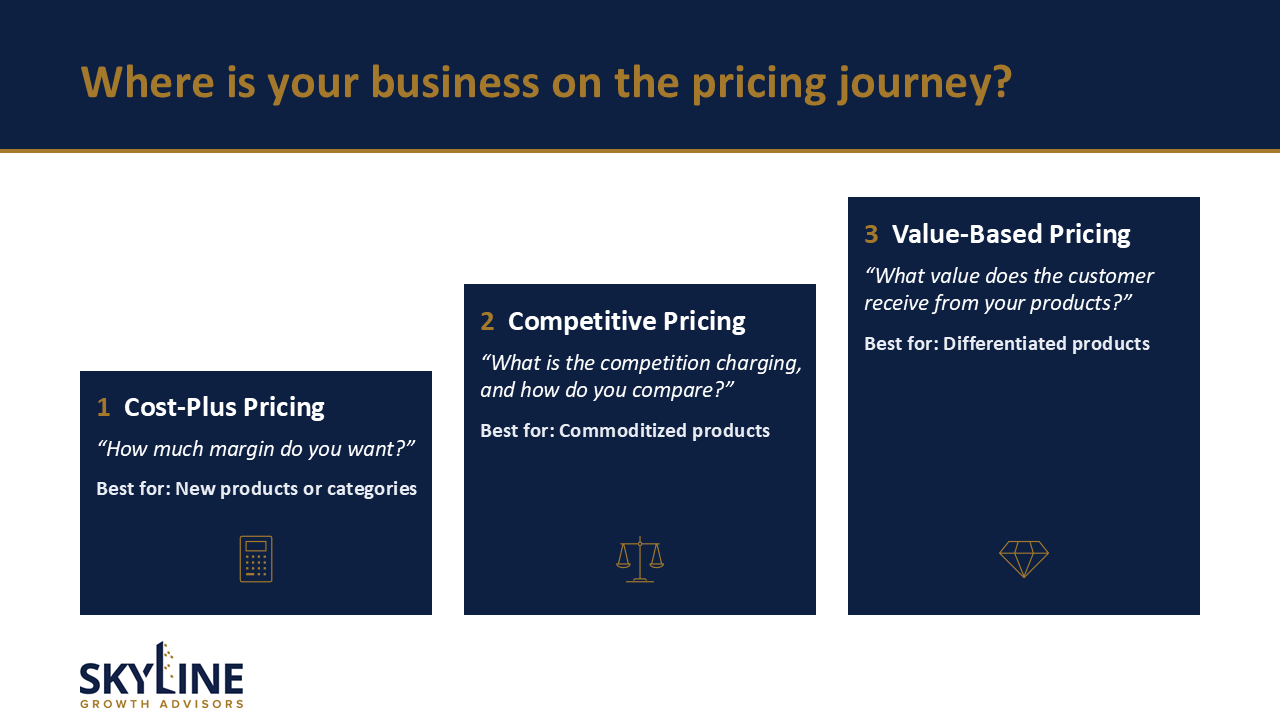
Cost-plus pricing is the first step on a pricing journey. For many e-commerce companies, it is also the last step, because other priorities take precedence. As the old adage says, “When is the best time to plant a tree? Twenty years ago. When is the second-best time? Today.” The same applies to taking the next step on your pricing journey.
Cost-plus pricing starts with you, and asks, “How much margin do you want?” Think about this for a minute. Is that really the best question to achieve a profitable business over the long term? Your company is leaving profit and possibly volume on the table by being inwardly focused. Cost tells you whether you can profitably sell a product. It shouldn’t tell you what to charge for your product.
As you step beyond cost-plus pricing, you shift into competitive pricing. Here you start to ask, “What is the competition charging for their products and how do you compare?” You are benchmarking your products against the competition, and determining your price using the competition as a reference. You balance volume and price level to achieve higher profit.
Your last stop in the pricing journey is value-based pricing, which asks, “What value does the customer receive from your products?” You’ve shifted to a customer focus, and you price your products according to the benefits the customer receives. This ensures you offer products at relevant prices that meet your customers’ needs, generating long-term profitability.
One of my e-commerce clients was looking to launch a new product category. They wanted a specific margin to start off with. After developing a pricing model and analyzing the impact on overall profitability, we launched a test, which we monitored closely. Over weeks, we launched additional products and observed which products caught on and which did not. We layered in periodic competitive market research to allow the team to adjust pricing and balance profitability and unit volumes. The new category became a majority of the revenue and profit for the client over the course of a few years.
Our client was comfortable remaining at this stage because their products were highly commoditized. Other e-commerce companies, especially those with differentiated products, might choose to move into value-based pricing over time.
Where does your business fall on the pricing journey? Is this a step you consciously chose, or did you stop there without realizing the impact on your profitability?
Related article: Your prices end in the same number
Share your comments below